Cancer in Rural India: Why Diagnosis Comes Late and How We Can Improve It

Written By
S K Ahmed• Founder, Rph (MBA)
Introduction
Cancer in rural India is often found late, not because people do not care, but because they are left to guess, wait, and travel without enough support. Many families do not know which symptoms matter, where to go first, or whether treatment will be affordable. WHO notes that early diagnosis is important for better cancer outcomes, and IARC works globally on cancer prevention and early detection.
At Heal Cancer Support, we believe that every person should have access to free early screening guidance, clear next-step advice, and help understanding government schemes before fear turns into delay.
Why cancer is often diagnosed late in rural India
One of the biggest reasons is low awareness. In a rural India study, many women responded “don’t know” when asked about cancer screening, which shows how much early education still matters for cervical, breast, and oral cancer.
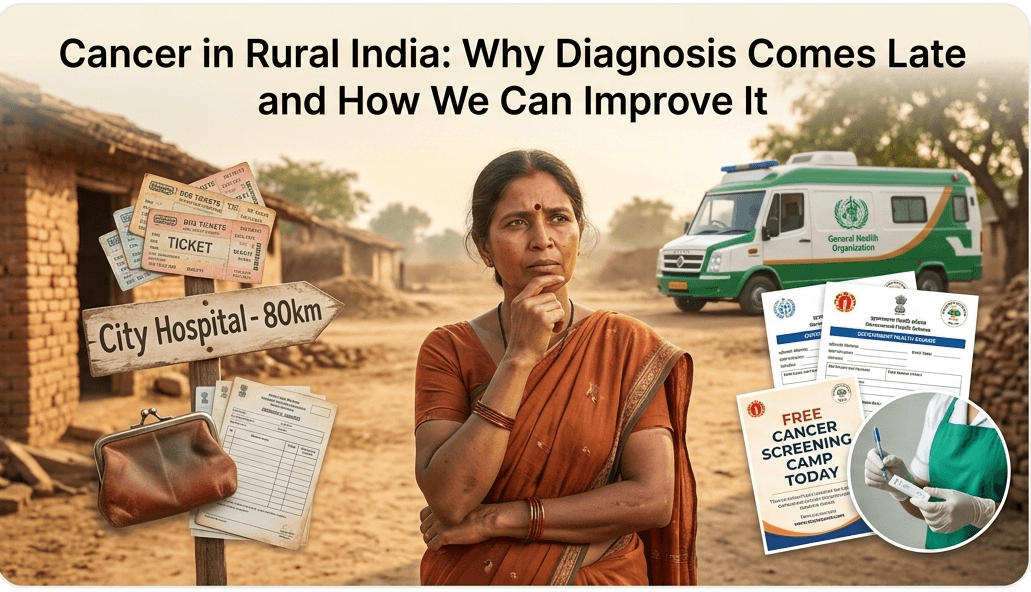
Another major reason is access. Rural families may live far from specialist centers, may not know where to get screened, and may delay care because of travel cost or confusion about referrals. IARC’s work in India specifically highlights the need to improve early detection and care access for oral, breast, and cervical cancers in rural populations.
A third reason is that people often do not act at the first sign of a problem. A small lump, bleeding, mouth ulcer, or long-lasting pain may be ignored until it becomes serious. WHO explains that timely diagnosis and referral are central to better cancer outcomes, especially in cancers that can be treated more effectively when found early.
Which cancers need the most attention
In rural India, cancers such as oral cancer, breast cancer, and cervical cancer need special attention because they are common, can often be screened early, and are strongly affected by delays in diagnosis and referral. WHO notes that cervical cancer is highly preventable and can be cured if detected and treated early.
How we can improve the situation
The answer is not only more hospitals. The answer is better early screening, simpler guidance, and stronger navigation.
Families need:
easy symptom checking,
free or low-cost screening support,
help understanding what test to do next,
and support using health insurance and government schemes.
That is where a cancer navigation platform like Heal Cancer Support can help. The goal is to reduce fear and confusion by giving patients and caregivers a clear first step. A simple screening tool, designed with medical guidance, can help people understand whether they should see a doctor, get a test, or seek specialist care.
Government schemes can reduce the burden
For many families, the cost of cancer care is one of the biggest fears. India’s Ayushman Bharat Pradhan Mantri Jan Arogya Yojana (AB PM-JAY) is the country’s major health assurance scheme, and official sources say it provides health cover of up to ₹5 lakh per family per year for secondary and tertiary hospitalization.
State-level support also exists, but it varies from state to state. The government’s myScheme portal lists state-specific health and cancer support schemes, showing that families may be eligible for additional help depending on where they live.
This is why scheme guidance matters so much. A family should not be left alone to figure out whether a government program can cover screening, tests, or treatment.
How Heal Cancer Support can help
Heal Cancer Support is built to make cancer care easier to understand. Our aim is to help patients and caregivers move from confusion to clarity with:
trusted next-step advice,
help finding the right doctor or test,
and support to understand government schemes such as PM-JAY and state-level options.
When people get clear guidance early, they are more likely to act early. That can make a real difference in cancer care.
Cancer in rural India becomes more dangerous when symptoms are ignored, screening is delayed, and families do not know where to go. The solution is early awareness, easy screening, free guidance, and stronger support for government scheme access. WHO and IARC both support the need for timely diagnosis and better access to care, especially in underserved communities.
Heal Cancer Support exists to help families take the next step with more confidence and less fear.
Worried about a symptom? Start with free screening guidance from Heal Cancer Support.
Get a simple next step, understand whether you need testing, and learn how to use available government schemes for cancer care.
References
IARC official site.
WHO cervical cancer fact sheet.
AB PM-JAY official/NHA sources.
Government myScheme portal.
Rural screening barrier study.
*This content is for informational purposes only and does not substitute for professional medical advice. All referenced materials and citations provided by the author are vetted for E-E-A-T (Experience, Expertise, Authoritativeness, and Trustworthiness) standards.

Written by
S K Ahmed
Founder, Rph (MBA)Founder at Heal Cancer Support 7+ Years of Exp in Health Sector
Discussions
0Loading conversations...